
Individual Retirement Accounts (IRAs) are often among the largest assets in a person's estate. However, many individuals overlook the critical role of properly naming IRA beneficiaries. A well-planned IRA beneficiary designation can reduce taxes, avoid probate, and protect loved ones. In contrast, mistakes can cause unnecessary legal proceedings and income tax consequences. This guide outlines key beneficiary scenarios under Michigan law and explains recent federal rules affecting retirement accounts.
What Happens if No Beneficiary is Designated?
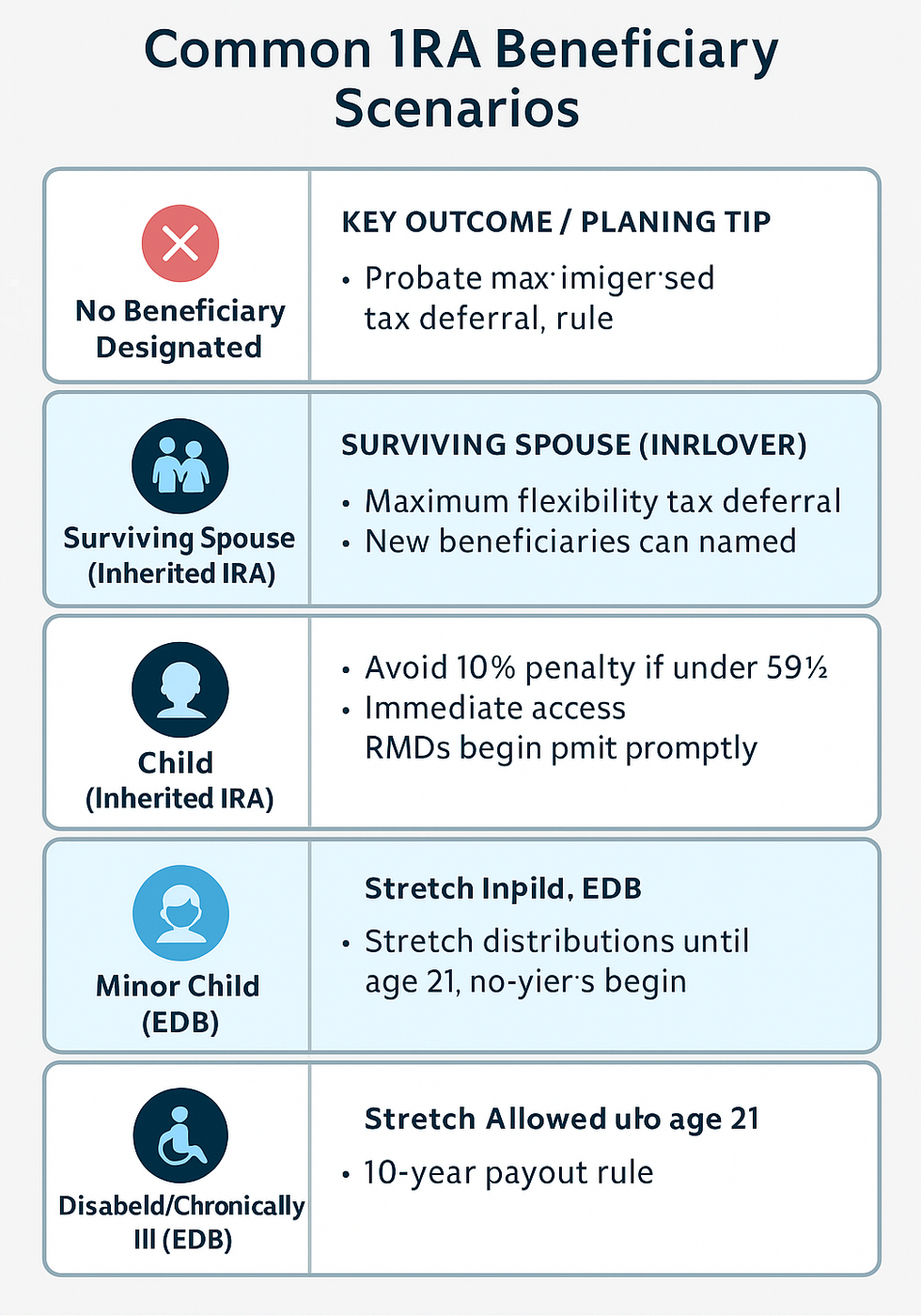
If no beneficiary is designated, the IRA contract terms typically determine who receives the account. The default recipient is often the deceased person's estate or surviving spouse.
When an IRA passes to the estate, two issues arise:
- Probate Required: The IRA will go through Michigan probate court, which could have been avoided with a proper beneficiary designation.
- Creditor Exposure: Unlike IRAs left directly to individuals, assets passing through probate may be subject to claims by creditors.
To protect your heirs, ensure that beneficiary forms are properly completed and up to date.
Transferring IRAs: Do Beneficiary Forms Carry Over?
No. When transferring an IRA from one provider or custodian to another, beneficiary designations do not automatically carry over. You must complete a new beneficiary designation form with the new custodian. Failing to do so may result in no beneficiary being listed, triggering probate and tax consequences.
Why the Surviving Spouse Is Often the Ideal Beneficiary
Surviving spouses enjoy special options not available to other beneficiaries. Most notably, a surviving spouse can:
- Roll the IRA into their own IRA
- Delay Required Minimum Distributions (RMDs) until age 73 (under SECURE Act 2.0)
- Name new beneficiaries for the account
This rollover gives the spouse full ownership of the account, continued tax-deferred growth, and maximum planning flexibility.
What if the Surviving Spouse Is Under Age 59½?
A younger surviving spouse needing access to the IRA may choose to treat it as an inherited IRA rather than rolling it over. This avoids the 10% early withdrawal penalty but requires RMDs to begin immediately. This strategy can be especially helpful for surviving spouses who need income before retirement age.
Children and the 10-Year Rule
Most adult children (age 21 or older) must inherit IRAs as Designated Beneficiaries, subject to the 10-year rule:
- Each child must establish an inherited IRA.
- The entire balance must be distributed within 10 years of the original account holder's death.
- Withdrawals can be spread over the 10-year period for tax efficiency.
A lump-sum distribution is allowed but can trigger significant income tax liability.
Minor Children, Disabled Heirs, and “Stretch” Distributions
Some beneficiaries qualify for an exception to the 10-year rule. These are known as Eligible Designated Beneficiaries (EDBs) and may use life expectancy-based ("stretch") distributions, which allow them to take smaller withdrawals over time and defer taxes.
Eligible Designated Beneficiaries (EDBs) include:
- Surviving spouse as noted above
- Minor child of the account owner (only until they reach age 21, after which the 10-year rule applies)
- Disabled individuals
- Chronically ill individuals
- Individuals not more than 10 years younger than the account holder (e.g., a sibling close in age)
These EDBs can stretch distributions over their life expectancy, preserving tax-deferred growth for a longer period.
Minor Children and Guardianship Issues
If a minor child is named directly as an IRA beneficiary, several options exist:
- Option 1 - UTMA Account:. Michigan's Uniform Transfers to Minors Act (UTMA) allows an adult custodian to manage the IRA funds on behalf of the minor until age 18 or, if extended by the IRA terms, up to age 21.
- Option 2 - Court-Appointed Conservator: If no UTMA account is set up, Michigan probate court may appoint a conservator to manage the funds until the minor reaches age 18. This process involves legal fees and ongoing court supervision.
- Option 3 - Use of a Trust: A properly drafted IRA trust can be named as the beneficiary for the benefit of the minor, helping avoid probate and allowing the trust to control the timing and use of distributions.
Why IRA Beneficiary Designations Deserve Careful Attention
By operation of law, the beneficiary designation for the IRA controls their distribution and overrides your Will or Trust. Your Will only distributes your IRA if you fail to designate a beneficiary or if you Will contains a testamentary trust and if you designate that trust as the beneficiary of your IRA. A Trust, such as a revocable living trust, only distributes the IRA if you designate the trust as the beneficiary of the IRA. Because IRA assets otherwise pass outside of a Will or Trust, mistakes in beneficiary designations can undermine your entire estate plan. Common issues include:
- Failure to update designations after life changes
- Unintended disinheritance
- Triggering unnecessary taxes or probate
- Losing “stretch” distribution options for EDBs
Important Note About Naming a Trust as IRA Beneficiary
While naming a trust as the beneficiary of an IRA can provide valuable protections—especially for minor children, beneficiaries with special needs, or blended family situations—it must be carefully drafted to comply with federal tax laws and IRA regulations. Improperly structured trusts can result in accelerated taxation, loss of deferral options, or disqualification as a designated beneficiary.
To preserve favorable tax treatment and ensure the IRA is distributed according to your intentions, always consult an experienced estate planning attorney before naming a trust as an IRA beneficiary.
Best practices for Michigan residents include:
- Reviewing beneficiary designations regularly (especially after marriage, divorce, birth, or death)
- Coordinating designations with your Trust or Will
- Seeking professional guidance on EDB rules, 10-year payout rules, and minor beneficiary planning
Ready to Maximize Your IRA Benefits?
Coordinating your IRA beneficiary designations is a critical part of the overall estate planning process. Improper planning can lead to unnecessary taxes, probate, or lost opportunities for your family.
If you have questions about IRA beneficiary designations, Eligible Designated Beneficiaries, or how recent legal changes affect your estate plan, I'm here to help.
I, Andrew Byers, am an estate planning attorney in Troy, Michigan with over 28 years of practical experience that I can share with you. Estate planning is one of the most important things you can do now to protect yourself, the people you care about, and your property, so feel free to contact me by using the online form or calling me directly at (248) 469-4261. On this initial call, for which there is no charge, I'll answer your preliminary questions and get some background information to make sure it's a situation that I can help with. After that, you can decide if it makes sense to schedule a more in-depth consultation.