
When you start thinking about the future, the first thing most people think of is a Will. It's the classic estate planning document we see in movies and read about in books. But as many Michigan families soon discover, a Will is often just the beginning of the story—not the end.
A recent Wall Street Journal article highlighted how "family trusts" are no longer just for the ultra-wealthy. They are becoming essential tools for anyone who wants to protect their family from the "three P's": Probate, Publicity, and Predators.
But does your specific estate plan need a trust? Let's look at how trusts work under Michigan law and why they might be the right fit for your family.
The Michigan Reality: Why a Will Isn't Always Enough
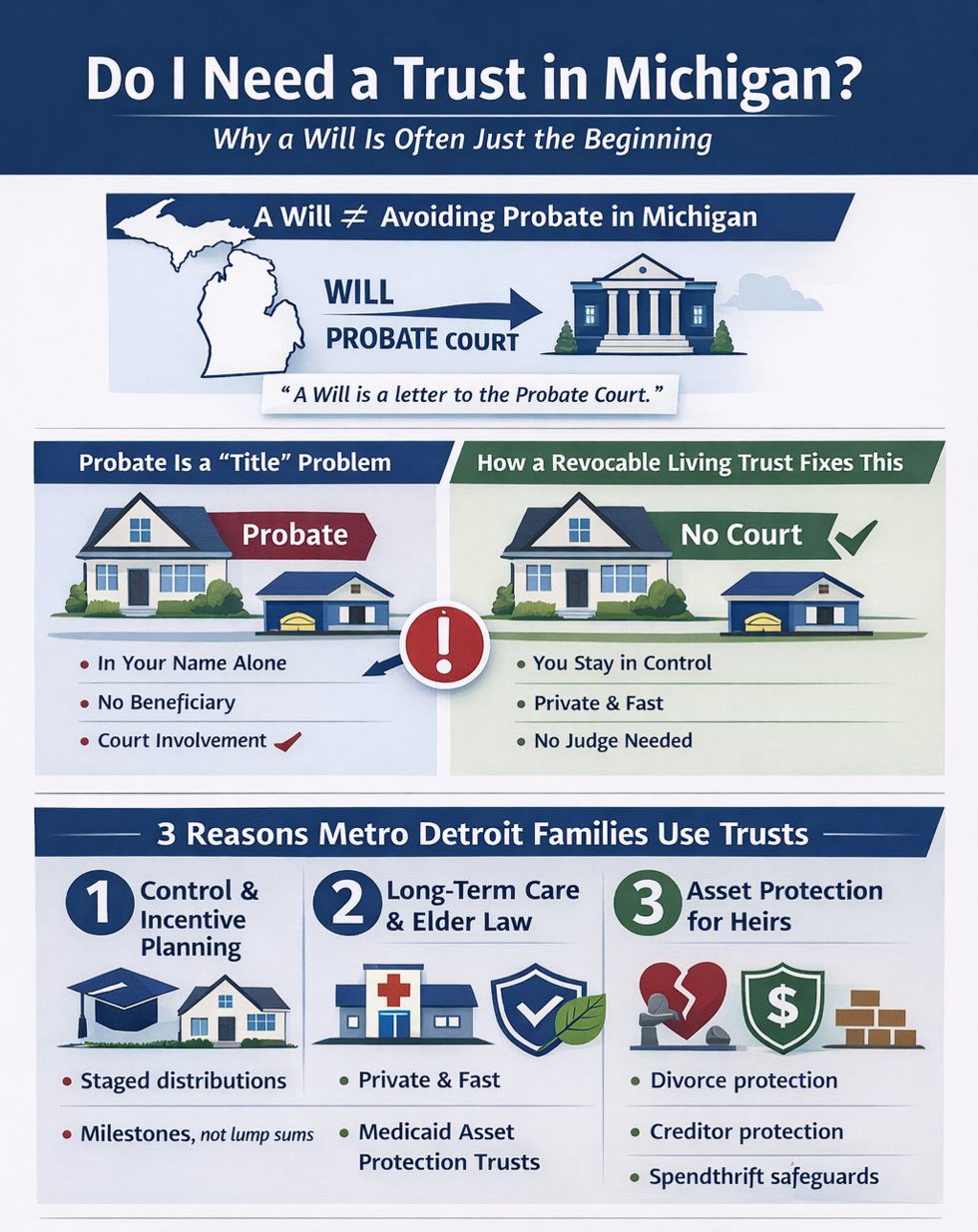
Many people believe that if they have a Will, their family is "safe" from court. In Michigan, the opposite is actually true. A Will is essentially a letter to the Probate Court. It tells the judge how you want your assets distributed, but the court still has to administer the process through Probate.
Why does probate happen? It occurs whenever a deceased person owns an asset titled solely in their name with no designated beneficiary.
In Michigan, probate can be:
- Public: Your assets, debts, and the names of your heirs become part of the public record.
- Cost Money: Between filing fees, publication costs, Inventory fees, and legal fees, probate can eat into the inheritance you intended for your kids.
- Take Time: Even a "simple" probate estate in Michigan typically takes five months to a year (or more) to close.
As an estate planning attorney, I often tell my clients that probate is a “title” problem. If an asset is titled solely in your name at the time of your death and has no beneficiary, a personal representative appointed by the Michigan Probate Court is the only entity with the power to move that title to someone else. The corollary? If you don't own assets in your individual name, you don't have a probate problem. By retitling your home, accounts, and investments into a Revocable Living Trust, you maintain full control while ensuring that legal “title” does not require the court system.
A Revocable Living Trust allows your assets to bypass the probate court entirely. Because the trust "owns" the assets, they can be transferred to your loved ones almost immediately upon your passing, without a judge's permission.
3 Reasons a Trust Might Be Essential for Your Michigan Estate Plan
- Protecting "Incentive" Inheritances. The Wall Street Journal noted a rising trend in "Incentive Trusts." If you have children or grandchildren who aren't quite ready to manage a large sum of money, a Michigan trust allows you to be the "pilot from the grave." Instead of a 21-year-old receiving a large check all at once, you can structure the trust to distribute funds in stages—perhaps at ages 25, 30, and 35—or for specific milestones like graduating from college or starting a business.
- Safeguarding Against Life's Uncertainties (Elder Law & Long-Term Care). As an estate planning and elder law attorney, I often work with "Solo Agers" or seniors concerned about the rising cost of nursing home care. A Will does nothing for you while you are alive regarding that issue. A trust, however, can include specific provisions for your own care if you become incapacitated. Furthermore, we can utilize Medicaid Asset Protection Trusts to help Michigan residents qualify for long-term care benefits while still preserving a legacy for their children. This is a level of protection a simple Will simply cannot provide.
- Protecting Your Heirs from Creditors and Divorce. Under the Michigan Trust Code, we can draft "spendthrift" provisions. This means if your child is going through a divorce or facing a lawsuit, the assets held within the trust are generally protected from their creditors. You aren't just giving them money; you are giving them a protected financial fortress.
Is a Trust Right for Everyone?
Not necessarily. If your assets are modest and your primary goal is simply to pass a small bank account to a single adult heir, a Will (paired with proper beneficiary designations) might suffice.
However, if you own real estate (especially an "Up North" cottage or a home in Troy), have minor children, own a business, or want to protect your assets from the costs of long-term care, a trust is often the most cost-effective and private solution.
Your Next Steps
Estate planning isn't just about documents; it's about peace of mind. In my estate planning and elder law practice, I help Michigan families navigate these complex choices with clarity and compassion.
Are you wondering if a trust is the right move for your family?
If you have questions about how a trust fits your specific situation I'm here to help. You can reach my Troy law office at (248) 469-4261 or via the contact form. We'll start with a brief, no-pressure phone call to discuss your goals and ensure I'm the right fit for your needs. From there, you can decide if a deeper consultation makes sense for you and your family.

Comments
There are no comments for this post. Be the first and Add your Comment below.
Leave a Comment